
In a previous post (Part 5 of this series) I looked at a range of issues that are testing the boundaries of copyright law and the principles that underpin them. In Part 6 I took a bit of a detour and reported on an important recent decision in the EU involving Kraftwerk’s successful case against music producer Moses Pelham, who had used a two-second drum rhythm sampled from the 1977 track Metall auf Metall.
In this post, I come back to the issue of derivative works, the process of homogenisation and the tricky concept of pastiche on the basis that these analogous areas of the law might one day assist in framing and implementing a conceptual orchestration standard.
Arguably, the best starting point is to look at the rules around joint authorship. Helpfully, case law provides some guidance for how conceptual contribution might be distinguished from mere technical assistance. For example, under U.S. copyright law, joint authors must make independently copyrightable contributions with the intention that their contributions be merged into inseparable or interdependent parts of a unitary whole.
In Thomson v. Larson,[i] the court denied joint authorship status to a dramaturge (a theater professional who serves as a kind of literary advisor and researcher for a theatrical production) who helped shape plot and structure, ruling that her role was characterised as an editor rather than co-author despite significant conceptual contributions. This case illustrates the high threshold for conceptual contribution to qualify as joint authorship.
In Gaiman v. McFarlane,[ii] the court recognised joint authorship in comic character creation even though individual contributions were not independently copyrightable, reasoning that if multiple people laboured to create a single copyrightable work, it would be paradoxical if no one could claim copyright.
These precedents suggest several frameworks for evaluating conceptual orchestration in AI contexts. The “substantial creative direction” test, drawing from musical arrangement precedents, could evaluate whether the human provided thematic and stylistic direction that shapes the AI’s output, structural frameworks that organise the creative work, and aesthetic judgements that guide selection and refinement of AI-generated content. The “copyrightable conception” standard, adapting joint authorship doctrine, would focus on whether the human’s conceptual contribution reflects original creative choices beyond mere technical operation, demonstrates sufficient creativity to warrant independent copyright protection, and integrates with AI output to form a unitary creative work. The editorial versus creative distinction, learning from Thomson v. Larson, must distinguish between editorial guidance (insufficient for authorship), creative conception and direction (potentially sufficient for authorship), and technical operation of AI tools (insufficient alone).
Practical applications of conceptual orchestration can be illustrated through a couple of practical examples. Let’s say a novelist uses AI to generate prose based on detailed character outlines, plot structures, thematic frameworks, and stylistic guidelines they created. The conceptual orchestration includes original character development and psychological frameworks, innovative narrative structures and pacing decisions, thematic integration and symbolic systems, and stylistic voice and tone parameters. An artist uses an AI image generator, let’s say DALL-E[iii]. The artist provides DALL-E comprehensive creative briefs, including original conceptual frameworks and artistic vision, detailed compositional and colour theory direction, cultural and symbolic content specification, and gradual and time-consuming iterative refinement. A composer employs AI for harmonisation and arrangement while providing original melodic and harmonic concepts, structural and formal frameworks, instrumentation and orchestration concepts, and stylistic and genre-specific direction.
In these examples, mapping out exactly who did what, when and how is likely to be inconclusive, if possible, at all. Unlike traditional joint authorship, AI-assisted creation makes it difficult to trace specific creative decisions and inputs to human versus AI contribution. The volume of AI-generated content may dwarf human conceptual input, raising questions about proportionality in authorship claims. However, human input may be just as important, for example, the quality of the prompts or the intuition and skill of the iterative refinement given to DALL-E along the way.
In addition, joint authorship requires intent to create a unified work, but AI systems cannot form legal intent, complicating the traditional analysis.
Courts could adapt joint authorship doctrine by treating AI as a sophisticated tool rather than a co-author, focusing on human conceptual contribution and creative direction, and evaluating the sufficiency of human creative input independently of AI output volume. Alternatively, AI-assisted works could be analysed as derivative works where human conceptual framework and direction constitutes the “original work”, AI implementation creates the derivative expression, and human orchestration and curation provides the requisite originality.
What is needed is recognition at a more fundamental level of the cognitive transformation theory and support for the “shared authorship” model I am putting forward. First, we need to recognise, as the Court did in Bartz v Anthropic, that AI training represents a fundamentally different cognitive process than traditional copying. Second, we need thinking that aligns with John Nosta’s concept that AI use is more like “conducting a symphony than writing a score.” Third, while the principle of transformative use is not, at least explicitly, part of copyright law in countries such as New Zealand and Australia, it is one that, in my view, should be adopted in our law to recognise the tension between copyright owners and authors.
The Bartz v Anthropic decision is relevant insofar as this area of the law is going through a period of rapid change and the trial judge endorsed the view that, in that particular setting, AI training was properly described as transformative use. Arguably, this supports my proposed framework for evaluating human conceptual orchestration in AI-assisted creation. The decision is also helpful insofar as it is careful in its separation of different types of reproduction, namely training versus library building, which again supports my argument for a more informed and nuanced analysis of different AI-related uses. Having said that, the ruling needs to be kept in perspective and the judge did not endorse transformative use as a principle of general application in AI cases.
[i] Thomson v. Larson, 147 F.3d 195 (2d Cir. 1998)
[ii] Gaiman v. McFarlane, 360 F.3d 644 (7th Cir. 2004)
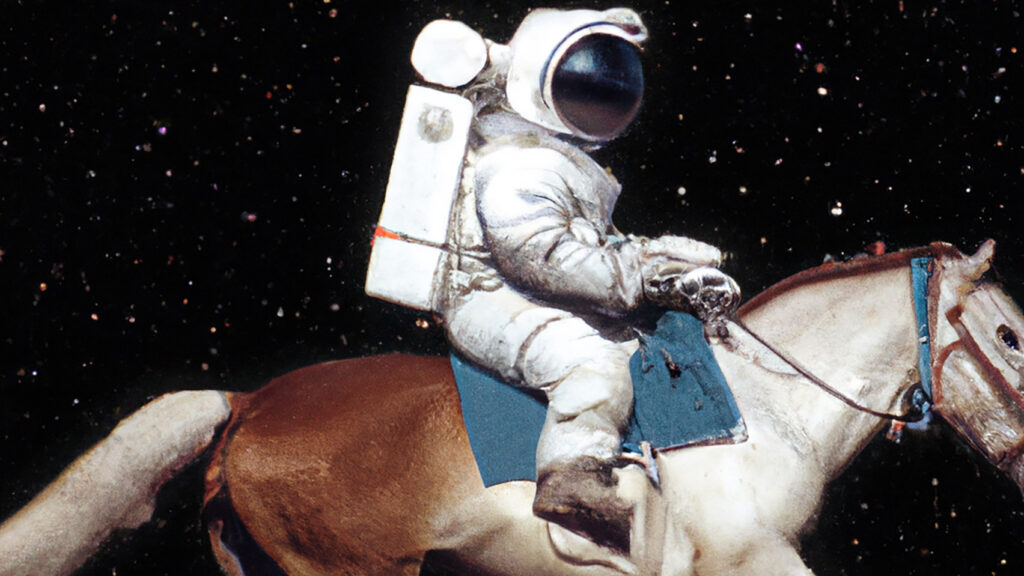
[iii] A nice play on words and a good tool for understanding complex prompts and producing high-quality, coherent images. The image in this post, depicting a astronaut on a horse, and pushing boundaries in the process, is a work created by or on DALL-E.