In my previous post (Part 4 in the series) I discussed a range of topics including whether derivative works are treated as original in some jurisdictions, for example the EU, and whether protection might also arise from efforts to reconstruct missing parts in an earlier work. AI has created unique challenges, because it operates in a completely different paradigm. For example, AI doesn’t just reconstruct or add missing parts in an earlier work LLM’s are able to scrape the entirety of say the Encyclopaedia Britannica, a unique and valuable source of old-world wisdom, and repackage and sell individual pieces of that knowledge and accumulated learning, to date with impunity.
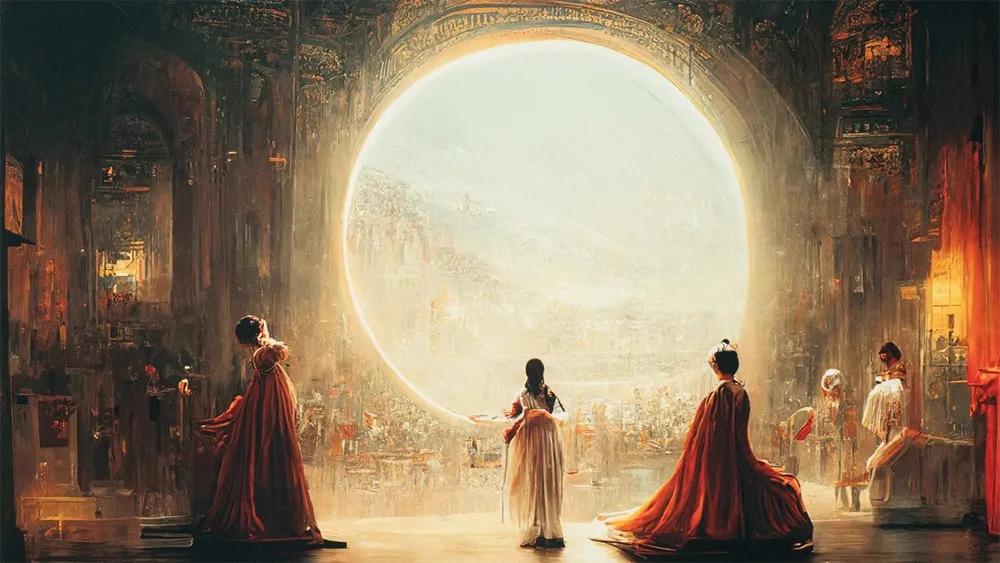
However, in searching its learnt knowledge-base and presenting a “sliver” of information in response to a user prompt, the question of whether this involves any degree of creativity or not will be entirely fact based. The question of originality and creativity becomes far more important and complex when generative AI is used and asked to create a complex and highly evocative visual image like the one in this post – Theatre D’Opera Spatial.
There are two main types of intelligence, human and non-human, the latter typically referred to, rather awkwardly, as artificial intelligence. Both are types of intelligence. The dichotomy is unhelpful though. Both types of intelligence have their strengths and weaknesses. Humans are good at reasoning, exercising judgment and intuition. We are also capable of assessing situations in an ethical and moral context. AI on the other hand, has no ethical or moral compass.
However, what it does very well is to analyse huge swaths of data and information and synthesise them and provide an instant and coherent answer to a prompt made by a human being or another AI schooled in writing better prompts. The whole spectrum of potential collaboration, from prompt writing, selection and correction to active problem-solving informs the question of whether free and creative choices were made by a human, thereby resulting in generative AI-assisted output that the law should recognise.
Rather than focusing on the differences between these two types of intelligence, we should be looking at the synergies and aligning them, the same way one would do when putting together a team of humans, where each person adds their own value and where the whole is greater than the sum of its parts.
How then do we combine the best of human and non-human intelligence in order to better humanity and the world we live in. First, by being open and welcoming new ideas, by combining our strengths and avoiding our weaknesses. Secondly, by discarding the naive notion that humans alone can create and invent. Thirdly, by seeing AI as a potential collaborator, rather than a threat and working together to author new works that bring together and manifest the best of the human and artificial creative streak.
Coming back to the question of whether humans alone can create and invent, Kristen French, an associate editor at the science publication Nautilus, conducted a very interesting interview with Silvia Rondini, a cognitive scientist at the University of Barcelona. The purpose of the interview was to enquire into whether recent research shows that AI is now, or in the future might be, able to play a genuinely creative role in the arts and more generally. Rondini is an expert in modern languages and literature, with a particular interest in the concept of creativity, and how verbal and visual creativity differs. The interview focuses on the intriguing question of whether AI has the capacity for true creativity.
Rondini points out that studies show generative AI models actually perform poorly at creating original or novel images, especially there is no real input from a human. In order to test this thesis Rondini and her colleagues compared the creativity of works created by four groups: human visual artists; non-artists from the general population; generative AI without any human support; and generative AI with human guidance. Each group was given a relatively abstract instruction and tasked with creating a drawing. The researchers then assessed and graded the output based on whether they pleased the judges, and whether they were vivid, original, aesthetically pleasing, and capable of arousing curiosity.
The results, published in Advanced Science[1], were clear: The visual artists consistently received the highest score for creativity, followed by the general population, the human-guided AI model, and by a wide margin, the unguided AI model.
What does this tell us? That, in its present form, unguided generative AI lacks creativity but that human guided AI, that is AI collaborating with humans or benefiting from human orchestration, does have the potential for genuine creativity. Perhaps that conclusion is unsurprising given that generative AI depends on collaborative human input and in most situations, it is only through such input that creativity potentially arises.
[1] Stable Diffusion Models Reveal a Persisting Human–AI Gap in Visual Creativity, Silvia Rondini, Claudia Alvarez-Martin, Paula Angermair-Barkai, Olivier Penacchio, Marc Paz, Matthew Pelowski, Dan Dediu, Antoni Rodriguez-Fornells, Xim Cerda-Company, First published: 24 March 2026: https://doi.org/10.1002/advs.202524142Digital Object Identifier (DOI)